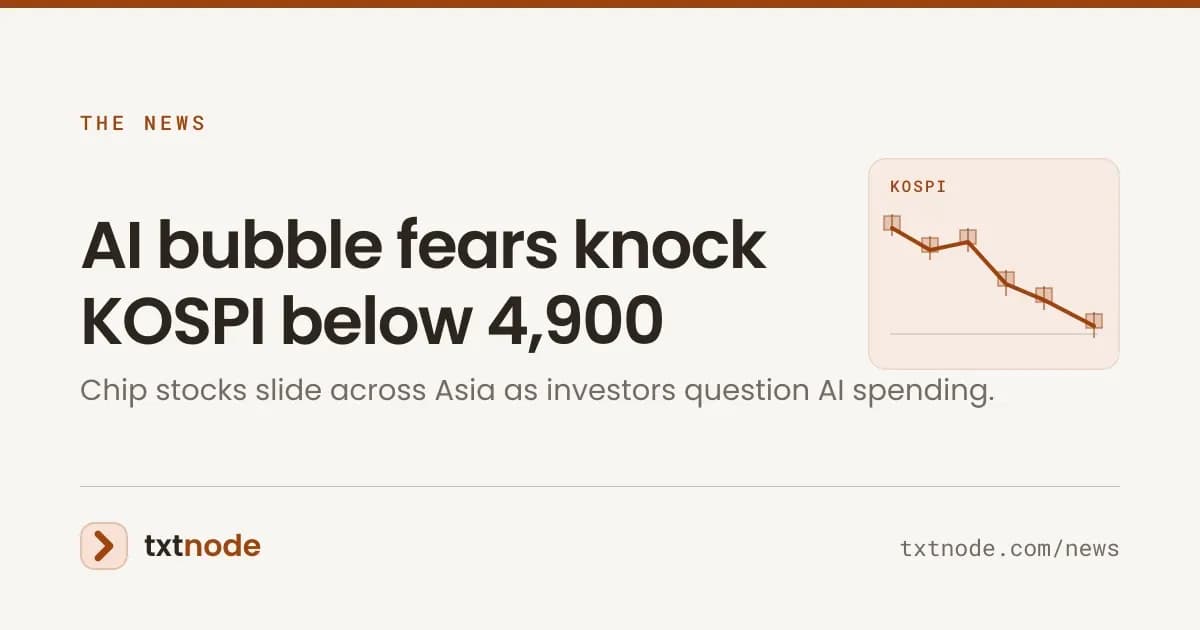
AI bubble fears knock KOSPI below 4,900 as chip stocks slide
South Korea's KOSPI fell 5.21% on Friday, dropping below the 4,900 level as worries about artificial intelligence valuations spilled from Wall Street into Asian chip markets. Samsung Electronics slid 7.01% and SK Hynix lost 5.92%, turning a debate about how much the world is spending on AI into a very concrete sell-off in the companies that make its hardware. The figures here come from BigGo Finance and BBC News.
The move was not confined to Seoul. Taiwan's TAIEX fell 6.23%, Japan's Nikkei 225 dropped 5.06%, and chip names including Kioxia and TSMC came under pressure. SoftBank, a major investor in OpenAI, closed 14.48% lower in Tokyo. By the time European markets opened, the sell-off had reached indices with far fewer technology companies: Germany's Dax ended 2.6% down, France's CAC 40 fell 1.9% and the UK's FTSE 100 lost 1%.
What actually happened
The immediate trigger was the Nasdaq debut of Anthropic, the company behind Claude. Its shares opened well above the offering price and closed its first day about 17% higher, a result that looked like a vote of confidence in frontier AI. The next session told a different story: the stock fell more than 12% at one point and gave back roughly half of that first-day gain.
That reversal mattered because Anthropic had been treated as the first real test of what the market will pay for a pure-play frontier AI company. A strong debut did not settle the harder question. Investors are now asking how the enormous sums going into data centres, chips and models will turn into cash flow, and how long they will wait.
Those doubts were already building. BBC News put recent AI spending by a small group of large technology companies at more than one trillion dollars over the past year. When a single sector accounts for that much of the market's expectation, a change in mood can move an index that is, in practice, heavily exposed to memory chips.
Why chip stocks took the hit
KOSPI is unusually sensitive to the memory cycle. Samsung and SK Hynix are not just companies on the index; they are a large part of why the index moves at all. When investors begin to question whether AI demand justifies current capital spending, the firms selling the silicon are the easiest place to express that doubt.
The sell-off was amplified by tighter United States semiconductor restrictions on China and by foreign investors reducing exposure. Brokerages including Morgan Stanley and Goldman Sachs cut their targets after the move. Yet not everyone read the fall as the start of a long decline. Some analysts argued prices had entered oversold territory, pointing to a gap between spot prices and contract prices that they believe the market had ignored.
That disagreement is the heart of the story. Demand for AI compute is still real. The dispute is over the price of that demand, and over whether today's infrastructure build-out will earn a return soon enough to justify current valuations.
The wider market response
In the United States, the S&P 500 closed 3.7% lower and the Dow Jones Industrial Average fell 1.9%, putting both in correction territory. The Nasdaq, with its heavier technology weighting, dropped 5.3%. Nvidia closed 13.7% lower, according to BBC, following reports of a securities regulator investigation that the broadcaster had not confirmed. Meta and Amazon were also down sharply.
The pattern was the same across regions: the more a market depended on AI-linked technology stocks, the harder it fell. That is why a company listing in New York could move an index in Seoul within two sessions. Modern market plumbing transmits sentiment faster than any fundamental change in a chip factory's order book.
What this means for builders
For developers and students, this is a useful moment to separate the technology from the trading. The tools released this year do not become less useful because a share price falls. If anything, a cooling market may push companies to show practical value rather than rely on the scale of their spending.
That shift is already visible in the questions being asked. Instead of asking which model is largest, buyers are asking what a system costs to run, what data it can trust, and whether it solves a problem people actually have. Those are better questions for the long run, even if they make for a noisy few weeks on the ticker.
This is a fast-moving story. The figures above reflect reports available on 22 November 2026 and are not investment advice. For more on the technology behind the headlines, see our AI, industry and computer science coverage.
Sources
- BBC News: Tech stock sell-off drags markets down as Anthropic shares slide, reporting on the Nasdaq debut and global index moves.
- BigGo Finance: KOSPI Breaks Below 4,900 as AI Bubble Fears Halve Chip Stocks, reporting on KOSPI, Samsung, SK Hynix and the oversold argument.