
What Is AI in Simple Words? How It Works & Examples
Artificial intelligence, or AI, is technology that allows computers to perform tasks that usually require human abilities. These tasks can include understanding language, recognizing objects, finding patterns, making predictions, solving problems and creating content.
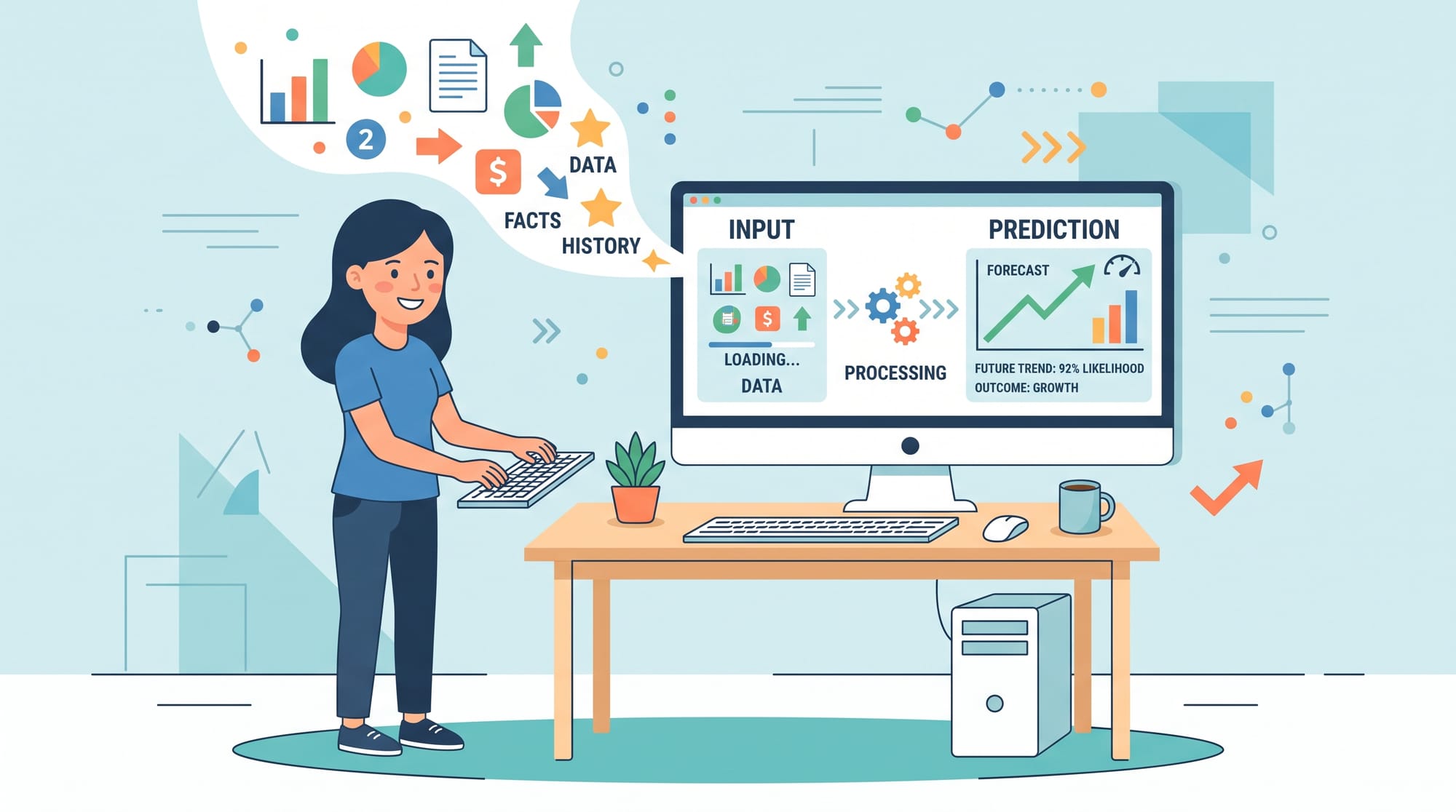
In simple words, AI helps computers use information to predict, decide, recognize or create.
A navigation app predicting traffic, an email service identifying spam and a chatbot answering questions are all examples of AI. However, AI does not think or understand the world exactly as a person does. It processes information using algorithms, mathematical patterns and trained computer models.
There is no single definition that perfectly covers every AI system because the term includes a wide range of technologies. NASA broadly describes AI as computer systems capable of performing complex tasks normally associated with human reasoning, decision-making and creation. (NASA)
AI in one sentence: Artificial intelligence enables computers to perform tasks that normally need human intelligence.
Key takeaways#
- AI helps machines recognize, predict, generate and sometimes act.
- Most modern AI systems find patterns in data.
- AI is already used in services such as maps, recommendations, fraud detection and chatbots.
- AI is not the same as every computer program or automated machine.
- AI can be useful, but it can also make mistakes or produce biased results.
- Important AI decisions still require human judgment and oversight.
What Is AI in Simple Words?#
Imagine that you want to teach a child to recognize a dog.
You could try to describe every possible dog: its size, ears, colour, shape and movement. That would be difficult because dogs can look very different from one another.
A more practical approach would be to show the child many pictures of dogs. Over time, the child notices common features and becomes better at recognizing dogs they have never seen before.
Many AI systems learn in a somewhat similar way. Developers provide examples or data, and the system finds patterns that help it respond to new information.
The comparison is not perfect. A computer does not learn with human awareness, emotions or lived experience. It performs mathematical calculations to identify relationships in data.
What can AI do?
Most AI tasks can be placed into four simple groups.
1. Recognize
AI can identify patterns in text, images, sound and other information.
Examples include:
- Recognizing a face in a photograph
- Converting speech into written text
- Identifying suspicious bank transactions
- Detecting unwanted email
2. Predict
AI can use past information to estimate what may happen next.
Examples include:
- Predicting traffic conditions
- Estimating delivery times
- Suggesting products a customer may like
- Forecasting equipment problems
3. Generate
Generative AI can produce new content in response to a request.
It may create:
- Text
- Images
- Audio
- Video
- Computer code
Generative AI systems learn patterns and relationships from large amounts of information and use those patterns to produce new outputs. (IBM)
4. Act
Some AI systems can take actions toward a goal.
For example, an AI agent may search available information, organize a workflow and use approved tools to complete parts of a task. Human-defined goals, permissions and safeguards still influence what the agent is allowed to do. (IBM)
What AI Is Not#
The word “AI” is sometimes used so broadly that almost every digital product appears to be intelligent. That can create confusion.
AI is not necessarily a robot
A robot is a physical machine. AI is software or a collection of techniques.
A robot may use AI to recognize objects or move through an unfamiliar room, but a simple factory robot can also follow fixed instructions without using AI.
AI is not the same as all automation
Automation means making a process operate automatically.
A traditional alarm clock is automated because it rings at a selected time. It normally does not need AI because it follows a fixed instruction.
AI is more useful when a system needs to handle changing information, recognize patterns or make predictions.
AI is not automatically conscious
A chatbot may use natural language and produce human-like responses, but that does not prove that it has feelings, awareness or a human understanding of its words.
AI is not always correct
AI can misunderstand information, miss important context and produce incorrect answers. Generative systems can also confidently present false information - a problem NIST calls “confabulation,” often known as hallucination. (NIST Publications)
How Does AI Work?#
AI can sound mysterious, but the basic process is easier to understand when divided into steps.
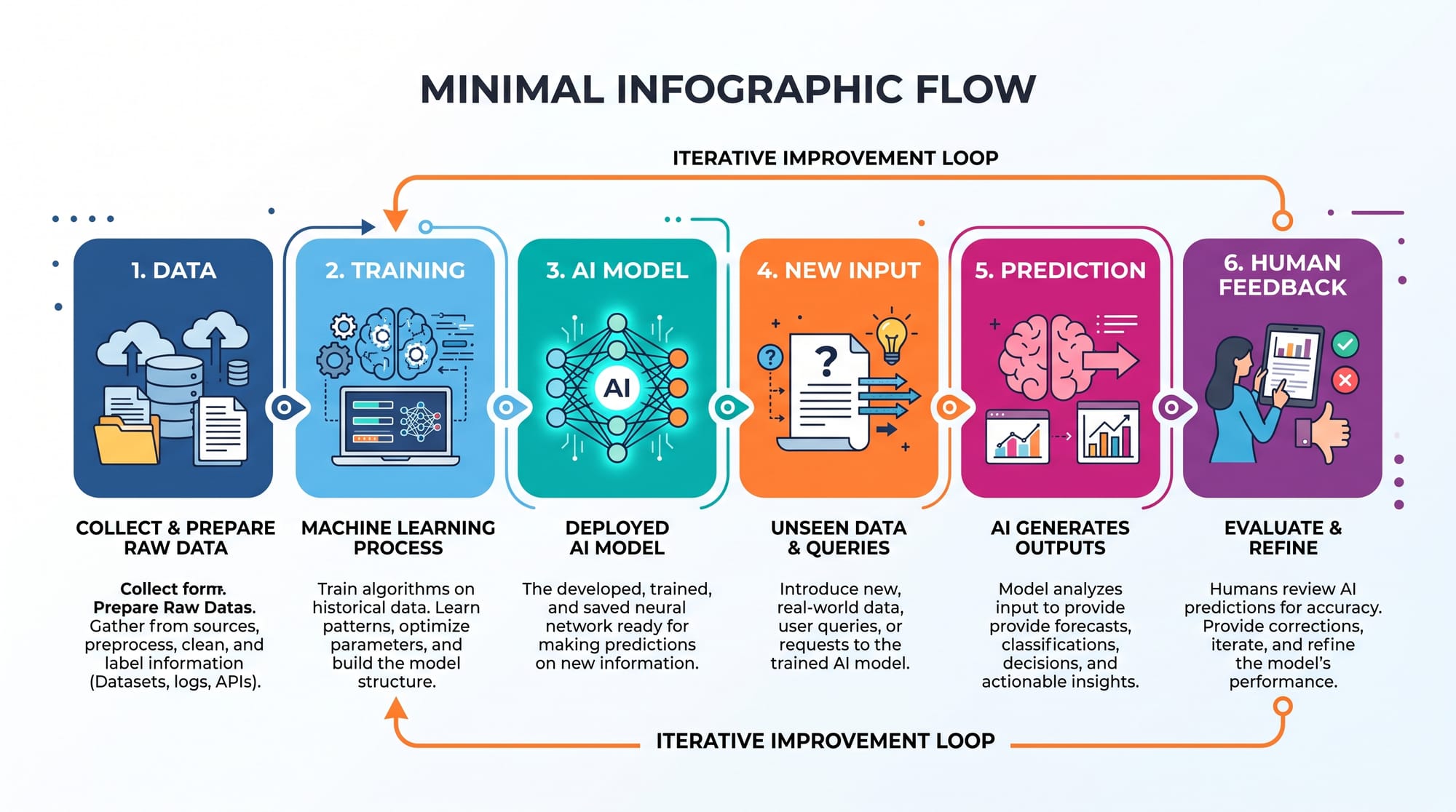
Step 1: A problem is selected
Developers first decide what the system should do.
For example:
- Identify spam
- Recognize objects
- Predict traffic
- Recommend music
- Generate an answer
A clear goal is important because one AI system is not automatically good at every task.
Step 2: Data is collected and prepared
Many AI systems need examples from which they can learn.
A spam filter might be trained using:
- Messages marked as spam
- Messages marked as safe
- Words and phrases in each message
- Information about senders
- Links or attachments
- Patterns found in previous unwanted messages
The quality of this information matters. Incorrect, incomplete or unrepresentative data can lead to poor results.
Step 3: An algorithm searches for patterns
An algorithm is a set of mathematical instructions.
During training, the algorithm examines the data and adjusts the system so that it becomes better at producing the desired result.
For a spam filter, it may discover that certain combinations of words, suspicious links or unusual sender behaviour often appear in unwanted messages.
Step 4: A trained model is created
The result of training is called a model.
A model is not necessarily a physical machine. It is a trained mathematical system that can receive new information and produce a result.
Machine learning is the branch of AI in which algorithms learn patterns from training data and use them to make predictions or decisions about new data. (IBM)
Step 5: The model receives new information
After training, the model can be given something it has not seen before.
For example, the spam model receives a newly delivered email.
Step 6: The model produces an output
The system may predict:
- Spam
- Not spam
- 92% probability of spam
The output is based on patterns learned during training. It is not based on human intuition.
Step 7: People evaluate the result
Developers and users can review the model’s performance.
They may ask:
- Did it block a safe message?
- Did unwanted mail reach the inbox?
- Does it perform fairly for different users?
- Is it reliable when the language or type of email changes?
The model may then be retrained, adjusted or replaced.
Not every AI model continuously learns while people use it. Some models remain unchanged until their developers update or retrain them.
A Simple Example: How an AI Spam Filter Works#
Suppose an email arrives with the subject:
“Urgent! You have won a free phone. Click immediately.”
The AI system does not feel suspicious in the way a person might. Instead, it examines patterns.
It may consider:
- Whether similar messages were previously marked as spam
- The reputation of the sender
- The number and type of links
- Unusual formatting
- Words commonly found in scams
- Whether the message was sent to many accounts
The model combines these signals and calculates a result.
If the email is classified as spam, it is moved away from the inbox. If the user later marks it as safe, that feedback may be used to improve the system.
The process can still fail. A legitimate competition email might look suspicious, while a carefully written scam might appear normal. This is why important systems need testing, monitoring and ways for people to correct mistakes.
AI vs Automation: What Is the Difference?#
Automation and AI often work together, but they are not identical.
Automation usually follows a predefined process.
AI often handles variable information by recognizing patterns, making predictions or generating outputs.
| Technology | Usually AI? | Reason |
|---|---|---|
| Basic calculator | No | It follows fixed mathematical rules |
| Digital alarm clock | No | It performs a predefined action at a chosen time |
| Automatic door sensor | Not necessarily | It may respond to a simple sensor signal |
| Email spam filter | Yes | It recognizes patterns and predicts whether a message is unwanted |
| Movie recommendation system | Yes | It predicts what a viewer may prefer |
| Generative chatbot | Yes | It generates responses using patterns learned during training |
| Self-checkout machine | Sometimes | Basic scanning is automation, while image recognition or fraud detection may use AI |
A system can contain both technologies. For example, an online store may use AI to detect a suspicious order and automation to place that order on hold.
AI vs Machine Learning vs Deep Learning vs Generative AI#
These terms are related, but they do not mean exactly the same thing.
| Term | Simple meaning | Example |
|---|---|---|
| Artificial intelligence | The broad field of building systems that perform intelligence-related tasks | A computer system that recognizes speech |
| Machine learning | A part of AI that learns patterns from data | A spam filter trained on previous messages |
| Deep learning | A part of machine learning that uses multilayer neural networks | An image-recognition system |
| Generative AI | AI that creates new content in response to instructions | A tool that generates text or images |
| AI agent | A system that can plan and perform actions toward a goal using available tools | A system that researches options and organizes the findings |
A useful way to remember the relationship is:
AI is the broad category. Machine learning is inside AI, and deep learning is inside machine learning.
NASA and IBM both present AI, machine learning and deep learning as related, nested concepts. (NASA)
Is ChatGPT a type of AI?
Yes. ChatGPT is an AI-based service designed to understand and respond to instructions by learning patterns from large amounts of information. It is an example of generative AI because it can generate responses and other content. (OpenAI Help Center)
That does not mean every AI system is a chatbot. A fraud detector, recommendation engine and traffic-prediction model may use AI without having a conversational interface.
What Are the Main Types of AI?#
There is no single universal list of AI types. Different sources classify AI according to its capability, behaviour, technology or purpose. Some categories can overlap. (IBM)
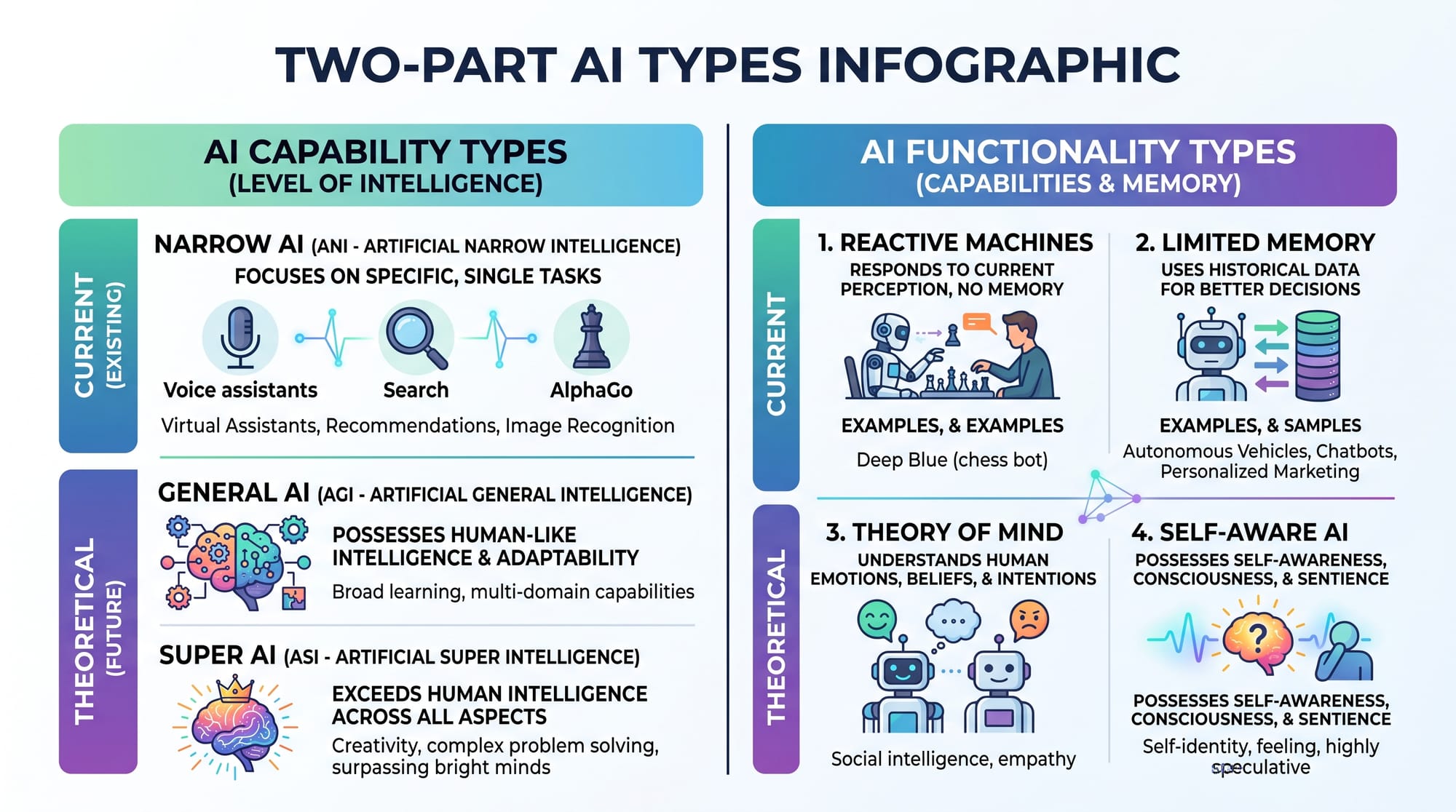
Two common methods are classification by capability and classification by functionality.
Types of AI by capability
1. Narrow AI
Narrow AI is designed to perform a particular task or limited group of tasks.
Examples include:
- Spam filters
- Recommendation systems
- Translation tools
- Image-recognition systems
- Generative chatbots
- Navigation systems
The AI tools currently used in everyday products are generally considered narrow AI. They may perform their selected tasks very well, but they do not possess unlimited human-level intelligence. (IBM)
2. Artificial general intelligence
Artificial general intelligence, or AGI, refers to a theoretical system able to learn and perform a wide variety of intellectual tasks at a broadly human level.
AGI remains a concept rather than an ordinary technology available today.
3. Artificial superintelligence
Artificial superintelligence, or ASI, describes a hypothetical form of AI that would exceed human intellectual ability across many areas.
It is a theoretical idea, not an established everyday system.
Types of AI by functionality
Reactive machines
Reactive AI responds to its current input but does not rely on a stored history of previous experiences.
A classic example is a game-playing system that evaluates the present position and chooses a move.
Limited-memory AI
Limited-memory systems use past or recently collected information to make predictions.
Many current applications - including recommendation systems and some driving-assistance technologies - fit broadly within this category.
Theory-of-mind AI
This theoretical category would understand people’s beliefs, intentions and emotions in a deeper and more human-like way.
Current AI can detect emotional signals or imitate empathetic language, but that is not the same as possessing a complete human understanding of another mind.
Self-aware AI
Self-aware AI would possess awareness of itself.
This remains a hypothetical idea. Human-like wording from an AI system is not evidence that it is conscious.
10 Examples of AI in Daily Life#
You may interact with AI several times without actively noticing it.
1. Email spam filters
Email services examine message patterns, links and sender behaviour to identify unwanted or dangerous mail.
2. Maps and traffic prediction
Navigation apps examine road information, traffic patterns and current conditions to estimate arrival times and suggest routes.
3. Movie and music recommendations
Streaming platforms analyze viewing or listening activity to predict which content may interest each user.
4. Search engines
Search systems use AI to understand queries, identify relevant information and organize results.
5. Voice assistants
Voice assistants can convert speech into text, interpret a request and produce a spoken response.
6. Autocorrect and translation
Language tools use patterns to suggest corrections, predict words and translate text between languages.
7. Fraud detection
Banks and payment services may use AI to identify transactions that differ from a customer’s normal behaviour.
8. Face and image recognition
Some phones use facial recognition to unlock a device. Photo applications may identify objects, locations or similar faces.
9. Customer-service chatbots
Chatbots can answer common questions, guide users through basic processes and direct complex cases to a human worker.
10. Generative AI tools
Generative tools can produce text, images, audio, video or code based on instructions.
Digital assistants, search engines, recommendations, shopping services, transportation tools, fraud prevention and text editing are all widely recognized examples of everyday AI applications. (Tableau)
Where Is AI Used?#
AI is not limited to technology companies. It can support work in many fields.
Education
AI can help create practice exercises, provide feedback, translate material and adapt learning resources. Teachers and students still need to verify generated information.
Healthcare
AI may help professionals analyze medical images, organize information and identify patterns. It should support qualified medical judgment rather than replace it.
Banking and finance
Financial organizations use AI for fraud detection, risk analysis, customer support and document processing.
Transportation
AI can support traffic prediction, route planning, driver-assistance systems and logistics.
Retail
Retailers use AI for recommendations, demand forecasting, inventory planning and customer service.
Manufacturing
Factories may use AI to detect defects, predict maintenance needs and monitor production.
Science
Researchers can use AI to examine large datasets, identify patterns and support simulations. NASA, for example, uses AI in areas such as mission planning and scientific data analysis. (NASA Science)
Cybersecurity
AI can help identify suspicious activity, malware patterns and unusual network behaviour. The same technology can also be misused, which makes security controls necessary.
Entertainment
AI supports recommendations, game behaviour, visual effects, editing and content generation.
Advantages and Disadvantages of AI#
AI is not automatically beneficial or harmful. Its effects depend on the system, the task and how people use it.
| Advantages | Disadvantages and risks |
|---|---|
| Can process large amounts of information | Can produce incorrect or misleading results |
| Automates repetitive tasks | May change jobs or required workplace skills |
| Finds patterns people may miss | Can reproduce bias in its data |
| Provides personalized recommendations | May create privacy concerns |
| Can improve accessibility | Some decisions can be difficult to explain |
| Supports work at a large scale | Can be misused for fraud, manipulation or cyberattacks |
| Can operate consistently | Requires infrastructure, energy and other resources |
Main benefits of AI
Faster information processing
AI systems can examine large amounts of data more quickly than a person could review manually.
Automation of repetitive work
AI can handle parts of tasks such as sorting messages, organizing documents or classifying images.
Pattern detection
Models can identify relationships that may be difficult to notice in very large datasets.
Personalization
Services can adapt recommendations, interfaces or learning materials to individual needs.
Accessibility
Speech recognition, text generation, translation and image description can make digital tools easier for more people to use.
Main disadvantages and risks
Incorrect information
AI-generated content can sound convincing even when it is false. Important claims should be checked against reliable sources.
Bias and unfair treatment
If data contains historical bias or does not represent certain groups well, an AI system may produce unfair results.
Privacy concerns
AI systems may process personal or sensitive information. Organizations need clear rules about how data is collected, stored and used.
Lack of transparency
Some complex models make decisions in ways that are difficult for ordinary users - and sometimes developers - to explain fully.
Security and misuse
AI can support useful security work, but it can also lower the effort required to create scams, misleading content or cyberattacks.
Environmental cost
Building and operating some AI systems requires computing infrastructure, electricity, cooling and physical resources. The size of the impact depends heavily on the model and how it is used. UNESCO includes environmental sustainability among the issues that responsible AI policy should address. (UNESCO)
NIST identifies reliability, safety, security, transparency, explainability, privacy and fairness as important characteristics of trustworthy AI. (NIST Publications)
Why Can AI Make Mistakes?#
AI does not have to be poorly designed to make a mistake. Even advanced systems have limitations.
Common causes include:
Poor or incomplete data
A system trained on inaccurate or limited information may learn unreliable patterns.
Unbalanced data
If some people, situations or languages appear less often in the training data, the system may perform worse for them.
An unclear request
A chatbot may misunderstand a vague question and answer a different question from the one the user intended.
A new situation
A model may encounter information that is very different from its training examples.
Pattern prediction without full understanding
Generative AI often produces content by predicting what should come next based on learned relationships. A likely-sounding answer is not always a factual answer.
Missing context
An AI tool may not know the user’s full situation, local rules or recent events unless it has access to that information.
Before relying on an important AI answer:
- Check its claims against reliable sources.
- Look for dates and missing context.
- Ask for evidence rather than trusting confident wording.
- Consult a qualified professional for medical, legal or financial decisions.
- Keep a human responsible for high-impact actions.
Is AI Good or Bad?#
AI is neither automatically good nor automatically bad.
Its effects depend on:
- Who develops it
- What data it uses
- What task it performs
- How carefully it is tested
- Who is affected
- What safeguards are present
- Whether people can challenge mistakes
- Whether humans remain accountable
An AI system that helps detect fraud may protect customers. A poorly tested system used to make important decisions may unfairly harm them.
Responsible AI therefore involves more than making a system accurate. It also involves fairness, transparency, privacy, security, accountability and human oversight. UNESCO’s ethics framework places human rights, dignity, fairness and oversight at the centre of responsible AI. (UNESCO)
Can AI Replace Humans?#
AI can replace or change certain tasks, but that does not automatically mean it can replace every person performing a job.
A job often contains several types of work.
For example, a teacher may:
- Explain a subject
- Design activities
- Notice when a student is struggling
- Resolve disagreements
- Encourage confidence
- Evaluate original work
- Make ethical decisions
AI may help create exercises or summarize material, but those tasks are only part of the teacher’s role.
The same is true in many professions. AI is often strongest when processing information, recognizing patterns or producing drafts. Humans remain important for responsibility, judgment, relationships, values and understanding complicated real-world situations.
The more important the consequence of a decision, the stronger the case for meaningful human review.
Who Created Artificial Intelligence?#
Artificial intelligence was not created by one person in a single moment.
Many mathematicians, engineers, computer scientists and researchers contributed ideas over several decades.
However, John McCarthy is closely connected with the name of the field. He organized the 1956 Dartmouth Summer Research Project on Artificial Intelligence, an event widely regarded as foundational to AI as an academic area. (Dartmouth)
Other early contributors developed ideas about computing, machine reasoning, learning and problem-solving. Modern AI is the result of work by a large international research community rather than one inventor.
Frequently Asked Questions#
What does AI stand for?
AI stands for artificial intelligence.
What is AI in simple words?
AI is technology that helps computers perform tasks such as recognizing information, finding patterns, making predictions or generating content.
What is AI in one sentence?
AI enables computers to perform tasks that normally require human intelligence.
What are three examples of AI?
Three common examples are email spam filters, navigation apps that predict traffic and streaming services that recommend content.
What are five common uses of AI?
Five common uses are image recognition, language translation, fraud detection, personalized recommendations and content generation.
Is ChatGPT artificial intelligence?
Yes. ChatGPT is an AI-based service that processes instructions and generates conversational responses. It is an example of generative AI. (OpenAI Help Center)
Does AI think like a human?
Not in the ordinary human sense. AI processes information and recognizes mathematical patterns, but human thinking also involves consciousness, emotions, physical experience and social understanding.
Is every robot an AI system?
No. Some robots follow fixed instructions and do not use AI. Other robots use AI for tasks such as recognizing objects, planning movement or responding to changing conditions.
Is AI the same as machine learning?
No. AI is the broader field. Machine learning is one method used to build AI systems. All machine learning is part of AI, but not every AI approach must use machine learning. (IBM)
Can AI learn by itself?
AI models can identify patterns during training, and some systems can adapt using new information or feedback. However, humans still choose goals, build systems, prepare data, set rules and evaluate results.
What is the difference between AI and automation?
Automation follows a process automatically. AI usually adds abilities such as recognition, prediction, generation or decision support. Many modern systems combine both.
What type of AI exists today?
The systems people use today are generally classified as narrow AI because they are designed for particular tasks. AGI and artificial superintelligence remain theoretical concepts. (IBM)
Final Thoughts#
Artificial intelligence is easier to understand when we stop imagining a human brain inside a computer.
AI is a collection of technologies that helps computer systems recognize information, learn patterns, make predictions, generate content and sometimes take actions.
It already appears in email filters, maps, recommendations, banking systems, search tools and chatbots. Its usefulness is real, but so are its limitations.
The most important lesson is simple:
AI can be a powerful assistant, but a confident computer-generated answer is not automatically a correct one.
People still need to decide where AI should be used, check its results and remain responsible for important decisions.